
During October and early November, Trenčín Castle (Slovakia), the site where the Treaty of Trenčín was signed in 1335, hosted important events and visits.
On October 9th, this castle, awarded the European Heritage Label and part of the “Places of Peace Route,” was chosen as the venue for the 17th General Assembly of the European Network of Places of Peace (ENPP). Representatives from Portugal, Germany, Slovakia, Hungary, Croatia, Romania, and the Netherlands participated in the Assembly, which approved several measures relating to the development of the transnational site “Places of Peace”, a European Heritage Label site, and the “Places of Peace Route,” currently undergoing certification as a Cultural Route of the Council of Europe . The election of the Association’s governing bodies for the 2026/2030 four-year period also took place there, that day.
On November 3rd, Trenčín Castle received a visit of a delegation from the Portuguese Parliament, headed by its President, José Aguiar-Branco, and the Portuguese Ambassador to Slovakia, Maria Poppe Lopes Cardoso, who learned about the history of this castle, its recent distinction as a European Heritage Label, along with 6 other sites located in 6 other Member States of the European Union and its role as part of Places of Peace Route.
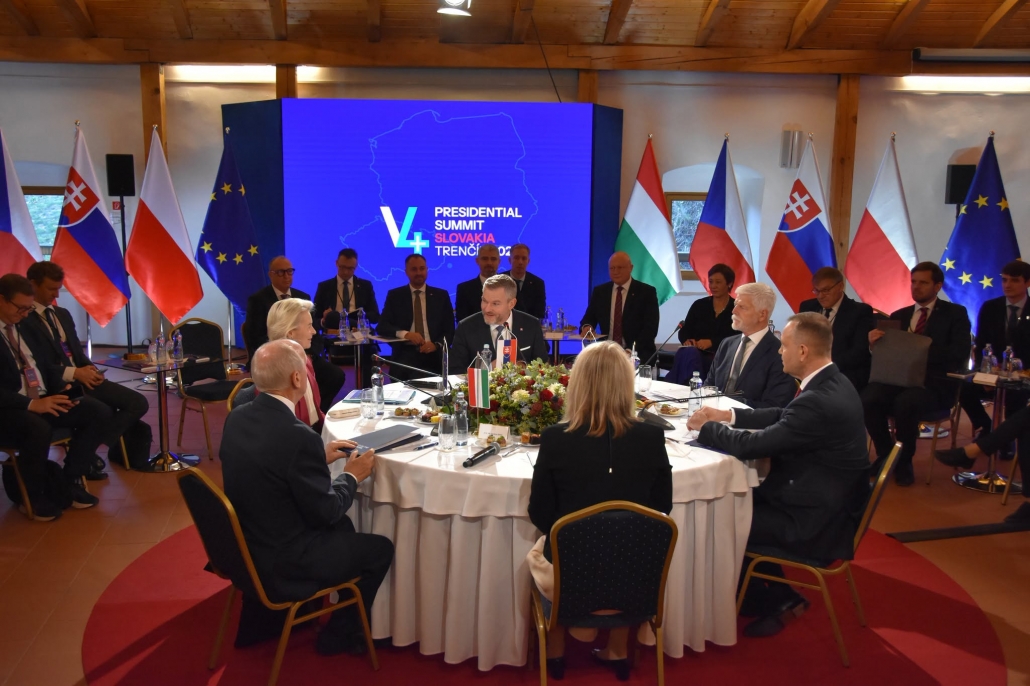
On November 5th, Trenčín Castle hosted a meeting between the Presidents of 4 Central European countries, Czech Republic, Slovakia, Hungary and Poland – a group of countries known as the Visegrád Group (V4) – and the President of the European Commission, Ursula von der Leyen.
Petr Pavel (Czech Republic), Peter Pellegrini (Slovakia), András Baka (Hungary) and Karol Nawrocki (Poland) and the President of the European Commission discussed the enlargement of the European Union, support for Ukraine and energy accessibility and availability in Central Europe.
The choice of Trenčín Castle for this Meeting has particular political and historical significance, since it takes place almost 7 centuries after, in the same location, the dignitaries of the kingdoms of Bohemia (present-day Czech Republic and Slovakia), Hungary and Poland established peace, fostered trade relations and promoted cooperation throughout Central Europe, by signing the Treaty of Trenčín, showing that the spirit of “Trenčín 1335” remains alive today.
Following the Treaty of Trenčín, partial treaties were signed in the city of Visegrád (Hungary) in November and December 1335 and January 1336, covering the unification of trade, taxes, and trade routes in Central Europe. These treaties are considered by many historians to be “precursors to the current European Union.”


